Master of Science in Industrial Design

The Master of Science in Industrial Design (MSID) is a two-year NASAD-accredited, STEM-designated professional degree committed to immediately applicable skills in human-centered design research and practice. Anchored in Houston’s and Texas’s medical, energy, aerospace, and entertainment industries, the program merges theory with hands-on practice so graduates can move quickly into real-world product, system, and service development. Graduates leave with industry-ready tools and perspective needed to create innovative solutions that improve products, experiences, and environments.
Careers with MSID at University of Houston
A Master of Science (MS) in Industrial Design at the University of Houston opens a broad range of career pathways that go beyond traditional product design. It emphasizes research, human-centered design, systems thinking, strategic innovation, and often interdisciplinary collaboration with engineering, business, and technology. This advanced degree typically positions graduates for more specialized, research-driven, or leadership-oriented roles compared to a bachelor’s alone.
Here, you’ll dive deep into research, human-centered design, systems thinking, and strategic innovation—working in our advanced graduate studio, an innovation lab equipped with cutting-edge research and product development tools—while collaborating across engineering, business, and technology. Our location in Houston gives you a powerful edge: the Texas Medical Center, NASA, and a thriving energy and tech scene become your living classroom and launchpad.
Graduates step into roles as Industrial and Product Designer, UX/UI Designer, Design Engineer, Design Researcher and Strategist, Design Manager/Director, Design Consultant, Design Educator, and Entrepreneur. Many go on to work with Fortune 500 companies, healthcare organizations, tech firms, and design consultancies—or launch their own ventures. Through a personalized curriculum focused on research and commercialization, plus optional certificates in Entrepreneurship (with UH’s highly ranked Wolff Center) or Foresight, you’ll gain the skills and confidence to turn bold ideas into real-world impact.
If you’re ready to design solutions that matter, the MSID program at the University of Houston is where your next chapter begins.
Degree Plan: Personalized Program of Study
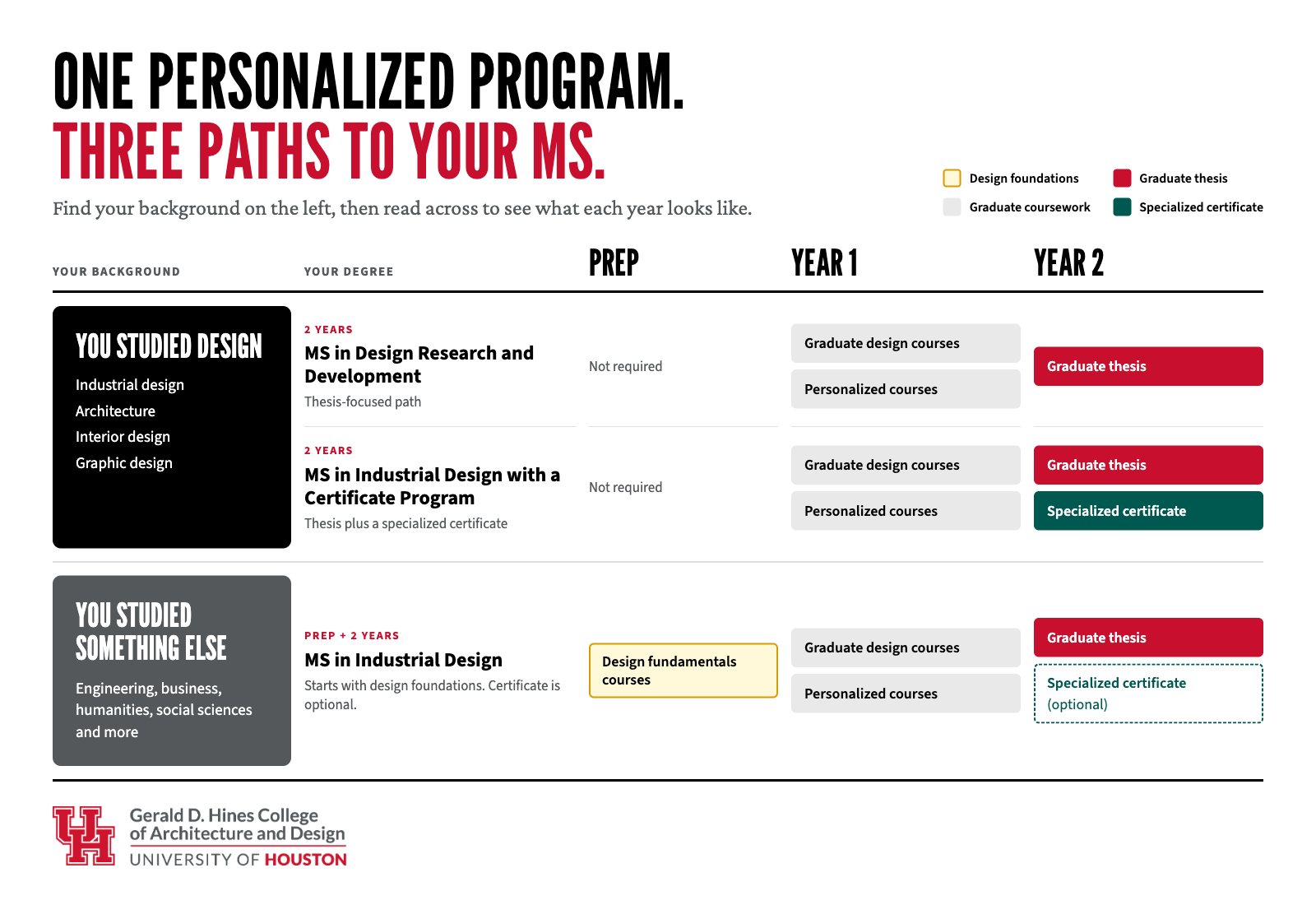
Each graduate student develops their personalized curriculum in consultation with the co-directors of the industrial design program based on the student’s needs, interests, background, and specific area of study. An interdisciplinary study plan of 36 credit hours (15 required, 9 ID electives, and 12 general electives) needs to be completed for graduation. Elective courses may be taken in other departments and colleges at the University of Houston, as needed.
The MS degree offers two certificate options with internationally recognized programs at the University of Houston:
- Entrepreneurship Certificate with the UH Wolff Center for Entrepreneurship (ranked #1 undergraduate entrepreneurship program in the US by the Princeton Review and Entrepreneur’s list of Top 50 Best Programs)
- Foresight Certificate with the UH Foresight Graduate Program to explore the future, as well as anticipate and prepare for change.
Candidates without an undergraduate degree in industrial design are advised to complete
an additional up to 17 credits to develop fundamental design thinking and visualization
skills. The co-directors and faculty of the ID program will advise and approve appropriate
courses, including undergraduate ID studios.
View the Degree Plan Apply Now
Research Areas
Healthcare Design
It is paramount to conduct thorough research to gain insights into prevailing challenges
and engage in collaborative efforts with community experts to devise tailored solutions.
Healthcare design constitutes a specialized realm wherein designers, engineers, and
community stakeholders converge to deliberate on pertinent issues facing both patients
and providers. Through a process of ideation, development, and implementation, innovative
solutions are crafted to effectively address these concerns and enhance healthcare
delivery. Visit the program page.
Faculty:
Elham Morshedzadeh, Ph.D.
Jeff Feng, Co-Director of Industrial Design
System Design and UX/UI Integration
Systems design is an approach extending beyond designing individual products to focus
on the interconnectedness of products within larger systems. It integrates principles
of systems theory into the traditional ID curriculum to help students think about
design more holistically and interconnectedly. The aim is to equip students with the
ability to design innovative, user-friendly, scalable, sustainable, and integrated
solutions within larger ecosystems. User experience (UX) and user interface (UI) design
are critical components in shaping digital interactions, influencing how users engage
with products in various contexts. UX design emphasizes understanding user behaviors
to create seamless experiences, while UI design focuses on crafting intuitive interfaces
for effortless navigation. Together, they enhance usability and satisfaction across
diverse platforms, extending their impact beyond the digital realm to enrich user
interactions in environmental contexts.
Faculty:
Min Kang
Sustainability
In the field of sustainability design, designers employ available resources to devise
solutions while considering the broader implications of their creations. Every stage
of product development, from conception to user utilization, carries environmental
consequences. Thus, conscientious material selection and manufacturing methods are
paramount to mitigate adverse impacts. The sustainability of a solution hinges on
its product lifecycle, underscoring the importance of thoughtful decision-making throughout
the prototyping process. By prioritizing sustainable materials and methods, designers
contribute to minimizing the ecological footprint of their designs and promoting environmental
stewardship.
Faculty:
George Chow